Brass sliding guides for log splitters: why do they make a difference?
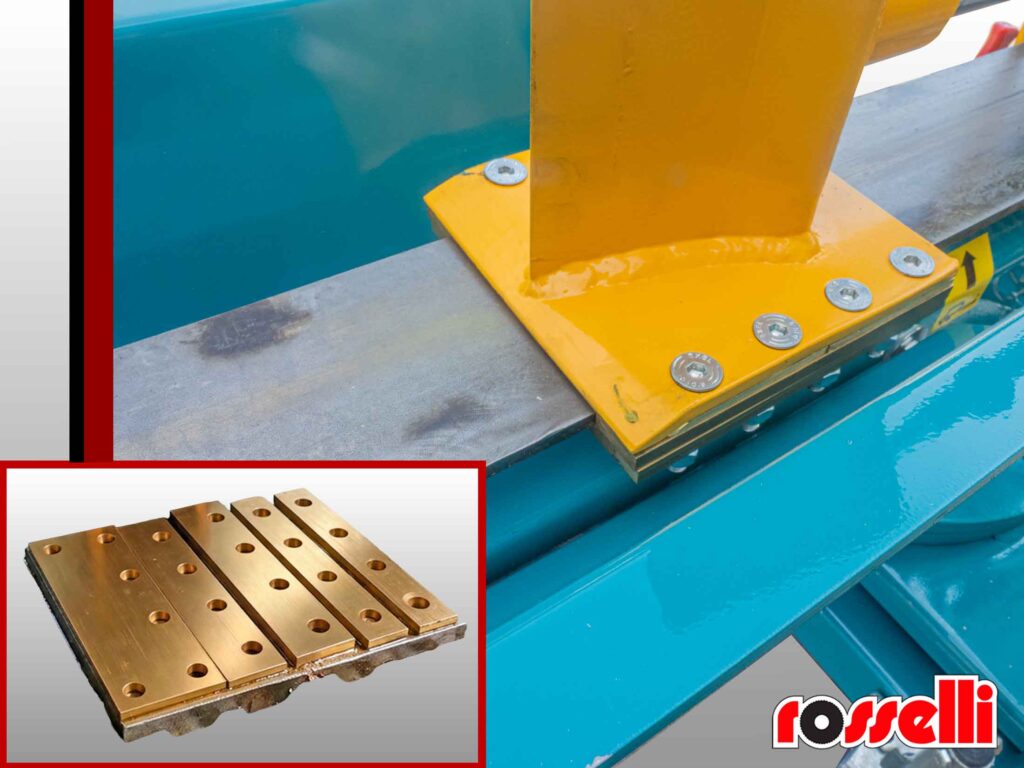
When evaluating the purchase of aprofessional log splitter, attention often focuses on the pushing force (expressed in tons), the type of drive (single-phase, three-phase, petrol-powered, or PTO-driven), or the speed of the hydraulic cycle. However, there is a crucial construction detail, often invisible at first glance, that determines the machine’s reallong-term durability,cutting precision, andreliability: the material of thewedge sliding guides.
While the market often offers cheaper solutions with industrial plastic or nylon pads,Rosselli Sncadopts a precise engineering choice for its professional and industrial models: the exclusive use ofbrass sliding pads.
In this article, we discover why this noble material represents the benchmark standard in the forestry sector and how it affects your everyday work.
The critical role of sliding guides in log splitters
During the splitting phase, the hydraulic forces at work are massive, often exceeding 10–22 tons, and the cutting wedge has to deal with extremely hard knots, intertwined wood, and strong structural resistance from the fiber. The guides have the essential task of directing the moving structure, or knife, along the steel support beam.
Without an ultra-resistant intermediate material capable of acting as a buffer, continuous metal-on-metal friction would cause:
- Rapid wear and deformation of the main beam.
- Dangerous mechanical play that can deviate the wedge’s path.
- Overheating of moving parts and drops in hydraulic power.
The 4 technical advantages of Rosselli brass slides
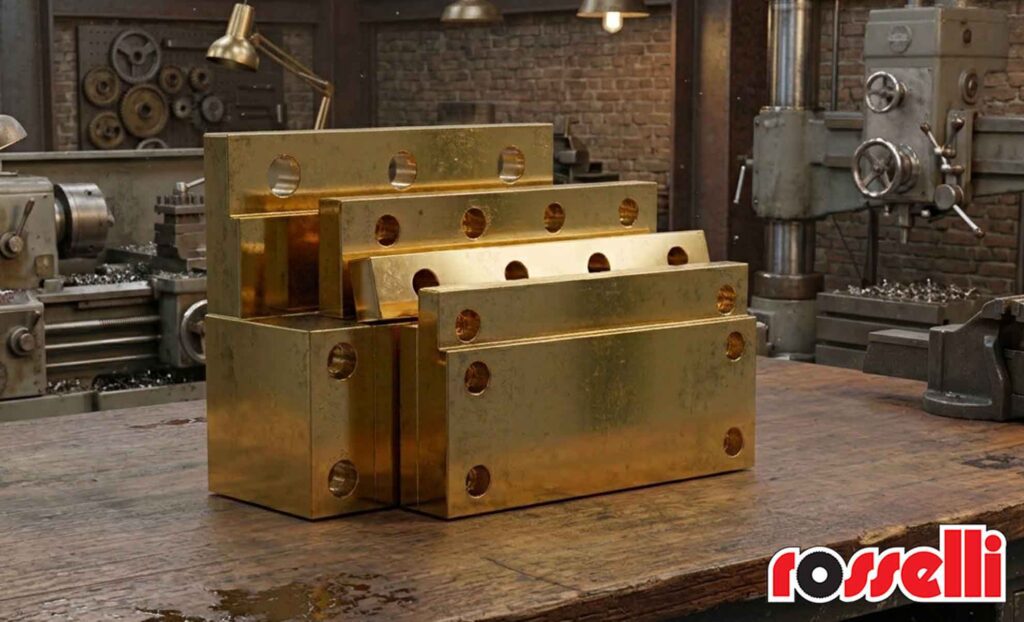
Brass is not a compromise choice, but a premium solution designed for heavy-duty construction and demanding professional use. Its benefits are directly reflected in the machine’s efficiency:
1. Very high mechanical strength and impact resistance
Brass is a robust alloy that does not deform under extreme pressure. Unlike guides made of plastic or inexpensive polymer materials, brass withstands the violent shocks generated when the wedge meets the hardest knots in the wood, keeping its structural shape unchanged.
2. Low metal-on-metal friction coefficient
Brass has excellent natural anti-friction properties when sliding on steel. This allows the wedge to move smoothly and consistently, reducing wear on both components and ensuring that all the power of the hydraulic cylinder is transferred to the log, without losses caused by friction.
3. Exceptional thermal stability
During intensive and prolonged work sessions, continuous rubbing generates high heat. Brass dissipates heat optimally and maintains its mechanical properties intact even at temperatures that would cause plastic slides to melt or deform.
4. Millimetric splitting precision
By eliminating the mechanical play typical of materials subject to rapid wear, the wedge penetrates the log while always maintaining the ideal and perfectly perpendicular path. This results in greater operator safety and uniformly split wood pieces.